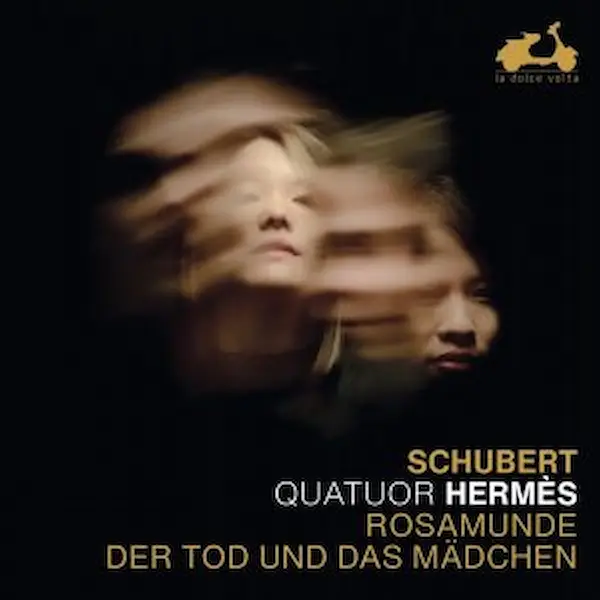
SCHUBERT // Rosamunde Der Tod und das Mädchen
15.00 €
At the gates of night and deliverance
By turns symphonic in dimensions and intimately lyrical, grippingly dark and gently enveloping, these two monuments of chamber music reveal the two faces of Schubert.
Choose your platform
Listen to the album
Introduction
About the album
Description
At the end of 1822, Schubert learnt that he had contracted a venereal disease. His hopes were ‘dashed’, friendship and love became ‘torture’. He threw all his energy into his work and embarked on the most profound portion of his oeuvre. This was the period of the song cycle Die schöne Müllerin, followed in 1824 by the ‘Rosamunde’ Quartet, the Arpeggione Sonata and the ‘Death and the Maiden’ Quartet. He left more and more works unfinished, but everything he did complete now took on a new dimension. His quartets are no longer for ‘accompanied first violin’: they gain in expressiveness, power and symphonic richness.
The String Quartet No. 13 in A minor D804, ‘Rosamunde’, was the only one printed and performed in public during Schubert’s lifetime. It is a work uttered in a murmur, with its tremolos, its unison melodies, its modulations. This string quartet is deeply touching in its confidences devoid of vehemence or drama. A nocturnal hymn to yearning, it is fragile and should be performed neither too desolately nor too lightly, always playing on the ambiguity between dewdrops and tears.
Schubert’s music is neither happy nor sad, but simply fraternal.
The String Quartet No. 14 in D minor D810, ‘Death and the Maiden’, is a work dictated by despair. Schubert concurs with Mozart’s remark that death is humanity’s best friend. He composed his quartet in D minor, the key of the Mozart Requiem.
The highly dramatic first movement is a struggle for life. In the second movement, Death is accepted. The drama returns in the third movement, now tinged with irony. And the work ends with a Dance of Death, a Presto in the form of a tarantella (the Italian dance invented to cure the bite of the tarantula).
The final chord affirms D minor. There is no doubt about the tragic outcome . . .
Credits and production
Technical information

Watch