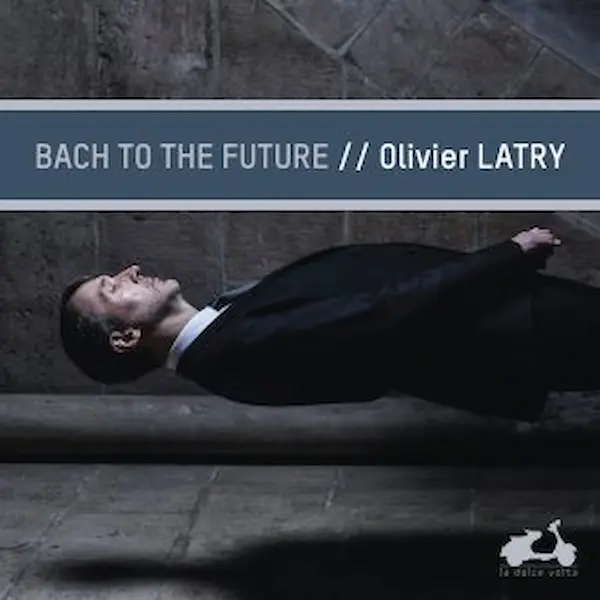
« "For a while, it seemed as if the cathedral’s famous organ had been lost, so it was fortuitous that Olivier Latry had just recorded this stupendous album. As we now know, the organ lives to be heard again, but this firey recording still presents the instrument in a spectacular blaze of color. Bach is well-served too!" »

BACH TO THE FUTURE // Vinyle edition
40.00 €
For his first CD with La Dolce Volta, Olivier Latry has chosen a programme devoted to the music of Johann Sebastian Bach. This recording, made on the massive Cavaillé-Coll organ of Notre-Dame de Paris, of which he is titular organist since 33 years, raises a number of fascinating questions because for him, “we must learn from the past in order to project ourselves into the future”.
Introduction
About the album
My approach highlights several paradoxes: the notion of performing these key works of Protestantism in one of the most emblematic centres of Catholicism, first of all, but also of playing them on an instrument that is, to say the least, far removed from the Baroque and Classical style of organ building. It’s quite true, all of this raises questions. However, the most important question remains, in my opinion, that of authenticity in music. I must confess that this concept often seems to me to be a decoy . . . Playing Bach in this context therefore implies finding a new balance in order to preserve the spirit and letter of music. One cannot be divorced from the other.
Every performer plays with the instruments of his or her time, and the instrument I have here at Notre-Dame is an outstanding one. One cannot and must not fight against the past, but on the contrary assimilate it, the better to derive inspiration from it and then find one’s personal path. We shouldn’t really be talking about authenticity at all, but, more soberly, about sincerity.
Programme
Bach to the future // Cavaillé-Coll organ of Notre-Dame de Paris
- Ricercare a 6 BWV 1079 9’36
- Fugue in G minor 4’44
- Toccata & fugue in D minor 10’07
- Choral Erbarm’ dich mein, o Herre Gott BWV 721 6’31
- Fantaisy in G minor BWV 542 7’16
- Fugue in G minor BWV 542 6’40
- In dir ist Freude BWV 617 3’23
- Choral Herzlich tut mich verlangen BWV 727 4’08
- Organ piece BWV 572 10’19
- Passacaille & fugue in C minor BWV 582 14’44
Credits and production
Technical information
Press reviews
Reviews and awards
« “Planned with phenomenal precision and played brilliantly and expressively … at no stage does mere virtuosity get in the way, tempi are never too fast and some of the approach is quite orthodox … Does Bach survive? Sure, and if we take this as a one-off, like the organ itself, you can’t help but admire Latry for his re-imaginings of this most familiar music. The booklet, incidentally, is beautifully produced.” »
« “He often solos out individual lines of polyphony, highlighting them with a contrasting color as one would expect in an orchestral texture.Latry is sensitive to the overall musical structure, and registers accordingly. The polyphony is always clear amid the ebb and flow of dynamics, bathed in seven seconds of reverberation. Latry skillfully combines Stokowski’s influence with aspects of period practice, such as clear, consistent articulation, which make these performances uniquely his own, true to his thesis of a compelling synthesis of traditions and practices. The recording itself is excellent, providing both clarity of the musical texture and presence of the instrument enveloped by its vibrant acoustical environment. The program booklet offers Latry’s comments, in interview format, in French, English, Japanese, and German. Several photos of Latry in various poses and of the organ are interspersed in its pages. Olivier Latry, one of the world’s great improvisers, is also a compelling interpreter of the music of Bach, following a long line of distinguished French organists, bringing it solidly into the 21st century. His name has become synonymous with the organ of Notre Dame, which he clearly loves. It is difficult to imagine his interpretations as heard on this recording having the same impact on any other instrument in any other space. This recording is a valid representation of Bach performance as informed by Latry’s vision of collective influence, played on an instrument that has been transformed over the centuries, yet remaining unified in its singularly distinguished voice. On this recording the organ, one of the world’s most cherished, sounds fabulous, in fine condition, unlike some recordings from earlier decades where it sounded tired and in need of some TLC.” »
« “I am not sure whether to call it thrilling or terrifying, but if you want to see a man go mad at the controls of a huge machine, check out the youtube clips of Olivier Latry improvising on the organ of Notre Dame de Paris, where he has been head organist for 34 years. His hands fly over the five manuals (keyboards) like whirling dervishes, fingers fluttering faster than the eye can follow, feet scampering across the pedals as if engaged in a frantic Irish jig. Fortunately, through, Latry’s latest all-Bach recording (on the Dolce Volta label, recorded at Notre Dame a few weeks before the fire) is a wonderful testament to what was there, and what will rise again.” »
« “Latry’s clever usage of the five keyboards and pedal makes for a slow crescendo, coming to a climax as the piece approaches its end .The engineering team of “La Dolce Volta” record label has met the task with a full-bodied recording that shows the grandiose of the organ (and the music), without losing important details. In the chorale “Erbarm’ dich mein, o Herre Gott”, BWV 721 (track 4) Latry also shows lovely refinement, and a celebratory rejoice in “In dir ist Freude” (BWV 617), where he uses the chimes of the instrument to create a bell effect. It’s worth noting that the order of pieces is cleverly chosen – with large, almost bombastic and long pieces followed by more tender, shorter pieces. And so a heart-warming piece like the choral “Herzlich tut mich verlangen”, BWV 727 (track 8) is followed by the cheerful “Organ Piece” (BWV 572) and the longest (perhaps the most impressive here), the Passacaglia and Fugue, BWV 582. Hopefully, the historic organ will prove to be able to survive not only time, but also disasters. In the meantime, there can not be a better testament to it, and to the talent of its dedicated player.” »
« “The Notre Dame sound, spectacularly caught by the La Dolce Vita engineers, brings a tremendous weight to the ponderous tread of the Erbarm’ dich mein, o Herre Gott (Chorale Prelude, BWV721), which along with Herzlich tut mich verlangen (Chorale Prelude BWV727) has the feel of a personal tribute about it. In the chorale In dir ist Freude, BWV615, he lets his hair down, using the organs ‘chimes’, (or jeu de cloches) to decorate the hymn tune with a golden peal of bells. Toccata and Fugue in D Minor, BWV565 (Latry’s first recording of the old warhorse), comes up all bronzed fanfares, burnished harmonics, twinkling lights and crushing dissonances, the bass notes echoing in the bottomless pit of the Notre Dame pedal resonance. The ‘Great’ Fantasia and Fugue in G Minor, BWV542 takes on the thunderous visionary quality of Liszt, aided and abetted by Latry’s thrilling, freewheeling conception. Most extraordinary is the mighty Passacaglia and Fugue in C Minor, BWV582, which Latry (with a little help from Marie-Claire Alain) reads as nothing less than a musical interpretation of the birth, life, death and rebirth of Christ. Evolving from out of the depths, over its 15-minute span it builds bit by bit to a gut-churning, unstoppable climax. Assuming you are on good terms with your neighbours, I dare you to turn it up loud!” »
« “This is a superb Gothic take on Bach played on the ultra-Romantic Cavaille-Coll organ. The Passacaglia benefits from a terrific extended crescendo.” »
« “Ah, this is more like it! Bach played with no hang-ups, using the full resources of a magnificent organ (the Cavaillé-Coll in Paris’s Notre-Dame Cathedral, which has happily survived the recent fire largely intact), happily discarding any ideas of authenticity and completely shorn of that kind of hallowed reserve with which so many organists treat it. This is a joyous celebration of Bach’s music, not a kneeling, hands-together, head-bowed worship of it … The playing is fabulous, no question about that, while the interpretations are idiosyncratic, to put it mildly … Even the most sanctimonious Bach purist could not fail to be impressed with Latry’s impeccable tracing of the contrapuntal lines in the BWV578 and BWV542 fugues, or with his gloriously fluent and magisterial account of the Passacaglia and Fugue … those of us who believe Bach’s music can not only survive but actually be positively reinvigorated by being taken out of its dusty glass case and injected with futuristic gadgets will feel we have been transported into a wonderful new galaxy.” »
« “This recording is a Shelby Cobra 427, wherein Bach’s compact North German masterpiece is the cute British sports car, the (now temporarily and sadly silenced) organ at Notre Dame Cathedral in Paris is the massive V8 engine, and Olivier Latry plays the part of Carroll Shelby in putting them together. The layered, increasing intensity of the middle section is utterly mind-blowing. Turn it up to 11.” »
« “If this recording of Bach, released last month, is to be the last we hear for a while from the great organ of Notre-Dame, it is thrilling testimony to that instrument’s power, to its spirituality, and to the talents of its organist, Olivier Latry.” »
« “For Olivier Latry’s disc Bach to the Future, a selection of Bach’s organ music for La Dolce Volta, Latry uses the Cavaille-Coll instrument at Notre Dame de Paris which was inaugurated in 1868 Latry uses the full range of the organ, his version of the Toccata and Fugue in D minor is positively thrilling, yet with great respect for Bach’s music so that the essential is always present. If Bach presented in rich colours and strong timbres, yet with a sense of the underlying structure, appeals then this disc is for you.” »
« “Olivier Latry, organist of Notre Dame, controls his majestic Cavaillé-Coll organ with great composure, knowing how to tame the enormous sound masses and how to subordinate them to Bach’s musical architecture. Only when the music allows it, Olivier Latry lets his organ off the leash, but without showing off, without becoming bold. In the booklet, the organist speaks of the transcendent power of Bach’s music and explains how to play baroque music on an organ like the Cavaillé-Coll without bringing Bach’s music out of balance. It is precisely this balance, the transparency and inner logic of the music that Olivier Latry never conceals. His performances never seem schematic, never purely intellectual. It is music that returns from the innermost to the innermost.” »
« “Mr. Latry recalled, he let the organ’s full volume swell, sending its musical colors reverberating around the Gothic building. “It sounded like Christ was entering the cathedral,” Mr. Latry said. “It was such a moving moment. I didn’t know it would be my last time.” »
« “Bach’s D Minor Toccata in Fugue played on the Cavaillé-Coll organ of Notre-Dame in Paris by the resident organist Olivier Latry, finding his own authenticity in Bach, inspired by the music, the instrument, the acoustic, even Stokowski’s orchestral transcriptions; did you spot one or two little decorative additions that weren’t Bach, I’m sure Mahan Esfahani would approve. The way Latry orchestrates Bach on this great instrument is a constant joy, whether you’re listening to one of the grand statements like the Toccata in fugue…or more intimate things, favourite chorale preludes or the Ricercar from Bach’s musical offering that opens the album. Eloquent playing, it’s a fine recording of one of the great French romantic instruments.” »
« “Released three weeks before the devastating fire, this thrilling recital is as much a celebration of Notre-Dame’s Cavaille-Coll as it is of Bach. With great artistry, Latry displays the instrument’s incredible sonic range, brings glorious Romantic excesses to the G minor Fantasia and creates a compelling crescendo through the Passacaglia” »
Watch
Video
Keep listening